
Choosing between a chest strap heart rate monitor and an armband heart rate monitor is less about finding one universally better device and more about deciding which form factor fits the way you ride. Structured outdoor training, indoor cycling, commuting, group rides, and mixed-sport use all create different priorities for accuracy, comfort, placement, pairing, and battery management.
For cyclists, the comparison becomes easier when you separate three questions. First, how is heart rate being sensed? Second, how well does the device fit your body position and clothing while riding? Third, does it connect conveniently with the bike computer, phone, or training app you already use? This guide walks through those decisions and explains where a chest strap or armband may be the better fit.
A chest strap heart rate monitor measures the heart's electrical activity, using the same basic principle as an electrocardiogram (EKG). A Cleveland Clinic study reported by the American College of Cardiology found that the chest strap tested closely matched EKG readings, with a level of agreement of rc = 0.996. In practical terms, the strap sits around the chest and sends the detected heart-rate signal to a compatible receiver or app.
An armband heart rate monitor generally uses optical sensing from the arm. In the same Cleveland Clinic study, wrist-worn optical monitors were less accurate on average than the chest strap, with agreement values ranging from rc = 0.67 to 0.92, and the wrist devices were notably inaccurate during bicycling. The main user-facing difference remains placement: one sensor is worn around the torso, while the other is worn on the arm.
That study tested wrist-worn optical monitors rather than cycling armbands, so its optical-monitor accuracy findings are related but not identical evidence for armband heart rate monitors. Product design, fit, signal quality, and the conditions of use still matter, so cyclists should compare the specifications of the actual monitor rather than assuming that form factor alone determines performance.
The strongest evidence supplied for this comparison comes from a 2017 Stanford evaluation of seven wrist-worn consumer devices in 60 participants. In that study, six of the seven devices measured heart rate with error under 5%. The same study found much larger errors in energy-expenditure estimates, with median errors ranging from 27.4% to 92.6%.
The important limitation is that this research tested wrist-worn devices, not cycling armbands specifically. It therefore supports a broader point: optical wearables can produce useful heart-rate measurements, but the study should not be used to claim a specific accuracy figure for an armband model that was not tested.
For cyclists comparing a heart rate monitor chest strap with an armband, that distinction matters. A chest strap is often chosen by riders who prioritize a dedicated training sensor and maximum data consistency, while an armband is often chosen for convenience and wearability. The evidence above does not justify inventing a numerical accuracy advantage for one ODIER form factor over the other.
It is also useful to separate heart rate from calorie estimates. The Stanford work found heart-rate measurement to be much more reliable than energy-expenditure estimation. That means riders should evaluate the monitor primarily as a heart-rate tool and avoid assuming that a connected app's calorie figure is equally precise.
A monitor that feels fine while standing can feel different after an hour in a riding position. Cycling places the torso forward, adds continuous leg and upper-body movement, and often involves sweat, tight jerseys, jackets, base layers, and hydration straps. That is why fit should be evaluated in the position and clothing you actually use on the bike.
A chest strap needs to be snug enough to remain in contact with the body without feeling restrictive. If it is too loose, some riders may notice movement as they lean forward or change position. If it is too tight, it can become uncomfortable during longer rides. Jersey contact and sweat are also practical factors because the strap sits directly under cycling clothing.
The riding position can make initial adjustment important. A strap that feels secure while standing upright may need a slightly different tension once you settle into the drops, hoods, aero position, or an indoor trainer posture. For regular users, the right adjustment usually becomes part of the pre-ride routine.
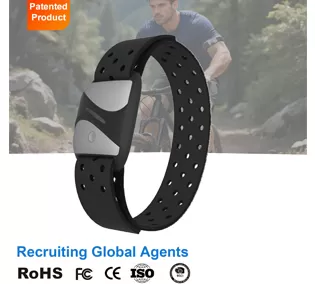
An armband moves the sensor away from the torso and places it on the arm, which some riders find simpler to put on and remove. Placement matters because the band needs stable skin contact without interfering with natural arm movement. Riders should follow the product's placement guidance and check whether the band remains secure over rough roads or longer sessions.
Winter clothing creates a different trade-off. A chest strap normally sits under base layers and jerseys, while an armband must also be positioned so that clothing does not force it to shift. For riders who frequently add or remove layers, ease of access may become part of the decision.
Comfort is personal, so the best armband heart rate monitor for one rider may not be the best choice for another. Some cyclists like the "put it on and forget it" feeling of a properly adjusted chest strap. Others dislike anything around the torso and prefer a sensor on the arm.
For long endurance rides, comfort should be judged over time rather than in the first five minutes. Ask whether the strap or band creates pressure, shifts when you sweat, conflicts with clothing, or makes you want to adjust it repeatedly. A monitor that is technically capable but annoying to wear is less likely to become part of a consistent training routine.
Indoor riders may have another priority: speed of setup. If you frequently jump onto a smart trainer for short sessions, an armband can be attractive because it is easy to see, access, and remove. Riders following structured sessions or race-focused training may still prefer the familiar feel of a chest strap if data consistency is their main priority.
A heart rate monitor for cycling is only useful if it can send data to the equipment you actually use. Before buying, check whether the monitor supports the connection standards required by your bike computer, phone, tablet, indoor cycling platform, or training app.
Connectivity should be checked against the devices you already own. The ODIER HR52, for example, lists BLE 4.0 and ANT+ connectivity in its manufacturer specifications. Before buying any monitor, confirm that its listed connection options match the receiver or app you plan to use.
Battery type also changes the ownership experience. A coin-cell chest strap can suit riders who prefer battery replacement without adding another frequently charged device to the routine. A rechargeable armband suits riders who would rather recharge the device than replace a battery. Neither approach is automatically better; it depends on how you manage training electronics.
Before a purchase, also think beyond today's setup. If you may add a different bike computer or indoor-training device later, broader connectivity can make the monitor easier to keep using across multiple riding environments.
| Rider Priority | Chest Strap | Armband |
|---|---|---|
| Structured training and data-focused riding | Often the stronger fit for riders prioritizing a dedicated training sensor | Can still work well when convenience matters more than traditional strap placement |
| Quick setup and removal | Requires positioning around the torso | Often easier to access directly on the arm |
| Torso comfort preference | Best for riders comfortable wearing a strap under clothing | Useful alternative for riders who prefer not to wear a chest strap |
| Battery preference | May use a replaceable coin cell, depending on model | Rechargeable formats are available |
| Indoor and casual riding | Suitable, especially for riders already used to chest straps | Convenient for frequent on-off use |
| Owning both formats | Useful for structured sessions or rides where a chest strap is preferred | Useful as an alternative when comfort or convenience is the priority |
If your main goal is maximum data fidelity for structured cycling training, a chest strap heart rate monitor is the more traditional choice. It fits riders who want a dedicated sensor for intervals, long training sessions, and regular use with bike computers or training platforms.
If convenience is the bigger priority, an armband may be more appealing. It is easier for many riders to see and access, and it avoids wearing a strap around the chest. That can make it attractive for casual rides, indoor cycling, shared equipment situations, or riders who simply dislike chest straps.
There is also no requirement to choose one format forever. Riders who train frequently may own both and select the one that fits the session. A chest strap can serve data-focused workouts, while an armband can be used when fast setup or different clothing makes it more convenient.
ODIER offers both chest-strap and armband options in its cycling training equipment catalog, giving riders and B2B buyers a way to compare the two formats within one supplier's range.
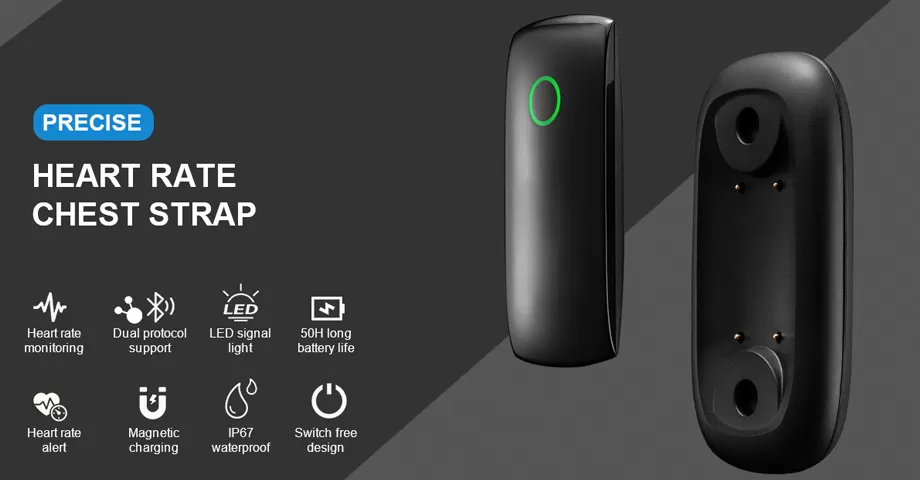
The HR52 chest strap heart rate monitor has manufacturer-listed specifications that include ±2 bpm accuracy in a quiet state, a measuring range of 30 to 240 bpm, ±1.5% accuracy, BLE 4.0 and ANT+ connectivity, IP67 waterproofing, and a CR2032 battery.
ODIER also lists the HR53 chest strap in its catalog. Further specifications are not included here because they were not verified in the supplied product brief.
For riders who prefer the arm-based format, ODIER also offers the DM51 rechargeable heart rate armband. It is listed as a rechargeable heart-rate armband; additional performance specifications should be confirmed on the product page or directly with the manufacturer rather than assumed.
For individual cyclists, these options make it possible to choose by wearing preference and training routine. For bike shops, cycling teams, distributors, and private-label brands, having both form factors available can also make it easier to build a product assortment for riders with different preferences.
The chest strap vs armband decision comes down to how you balance training priorities and day-to-day convenience. A chest strap heart rate monitor is the more traditional fit for cyclists who prioritize a dedicated heart-rate sensor and structured training. An armband can be the more comfortable or convenient choice for riders who prefer arm placement, quick access, and rechargeable use.
Accuracy claims should be handled carefully. The Stanford evidence shows that wrist-worn optical devices can measure heart rate reasonably well in many cases, but that study does not provide an armband-specific accuracy figure. It also shows why heart-rate data should be treated separately from calorie estimates, which can carry much larger errors.
Choose the format that you are most likely to wear consistently, confirm that it pairs with your cycling devices, and make battery management part of your normal routine. Riders can compare ODIER's HR52 and HR53 chest straps with the DM51 rechargeable heart rate armband to find the form factor that best fits their training style. Bike shops, cycling teams, distributors, and other B2B buyers can contact ODIER at carrie@odier.com.cn for wholesale, customization, OEM, or ODM inquiries.