
Choosing the best bike lights for night riding is not simply a matter of buying the brightest model you can find. A useful night-riding setup has to help you see the road or trail, make your position easier for other road users to detect, stay secure over vibration, and last for the full length of your ride. The right balance depends on where you ride, how fast you travel, how much ambient lighting is available, and whether your priority is commuting, road training, gravel riding, or mixed use.
For riders, the buying decision should focus on practical performance rather than one headline specification. For bike shops, distributors, and private-label brands, the same principle applies at product-selection level: the light should match the use case, mounting expectations, battery requirements, weather exposure, and the needs of the target customer. This guide explains how to evaluate a bike light for night riding without overcomplicating the process.
Night riding changes both visibility and reaction demands. In the United States in 2023, 53% of pedalcyclist fatalities occurred in dark conditions, compared with 42% in daylight; dusk accounted for 3% and dawn for 2%. An earlier National Transportation Safety Board study also found that roughly 45% of U.S. bicyclist fatalities from 2014 to 2016 occurred in dark conditions, while national travel survey data estimated that fewer than 20% of bicycle trips took place at night.
Those figures do not mean that a light alone can eliminate night-riding risk. They do show why lighting deserves more attention after dark. In daylight, riders can often rely on natural light and broader visual contrast. At night, the equipment has to do more: illuminate hazards ahead, communicate your presence from behind, and remain dependable throughout the ride. That makes front and rear bike lights part of the core night riding gear rather than an optional accessory.
The practical takeaway is simple: choose lighting as a system. Think about what you need to see, how you need to be seen, how long the ride will last, and how securely the lights will stay in position.
Lumens are useful because they describe light output, but they should not be treated as the only buying criterion. The amount of light that feels appropriate on a well-lit city street can be very different from what is useful on a dark rural road, gravel route, or unlit trail. Riders in areas with strong street lighting may need more emphasis on being visible and maintaining a controlled beam. Riders on unlit routes need enough usable forward illumination to read the surface and recognize obstacles in time.
That is why beam pattern matters as much as raw output. A very bright light with a poorly controlled beam can place too much light in the wrong area. A more useful best bike headlight directs light where the rider needs it: forward onto the riding line, with enough spread to give context around the path. For road commuting, a controlled beam is especially important because riders share space with drivers, pedestrians, and other cyclists. For gravel or off-road riding, broader coverage can be helpful because surface changes may appear outside a narrow central beam.
When comparing bicycle lights for night riding, ask three questions: Does the light illuminate the distance and width you actually need? Does the beam remain useful when mounted at your normal handlebar angle? Can you choose lower-output modes when full power is unnecessary? These questions are usually more practical than choosing by the largest lumen number alone.
For most night-riding situations, a complete setup includes both a front light and a rear light. They solve different problems. The front light helps you read the route ahead and makes your bicycle more noticeable from the front. The rear light helps approaching traffic identify you from behind. Using both creates a more complete visibility setup than relying on only one direction.
A front light is especially important when the route is poorly lit, the surface changes frequently, or you ride at speeds that require more time to identify hazards. A rear light remains important even on illuminated roads because streetlights do not guarantee that a rider is visually distinct from the background.
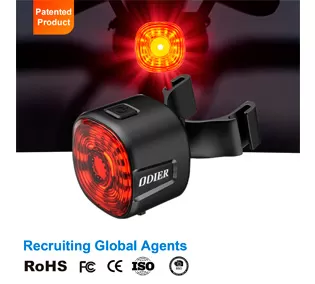
Rear lights can also add useful signaling features. For example, ODIER's intelligent sensing bike brake taillight is available in an auto brake-sensing version with day and night modes. It can mount on the seat tube, cushion, or bag, giving riders flexibility in how the rear light is positioned.
Battery life should be evaluated against the way you actually ride. The first question is not "What is the maximum runtime?" but "Will the light comfortably cover my typical ride with a sensible reserve?" A short urban commute and a long evening training ride place very different demands on a light.
Runtime also depends on the mode you use. High-output steady modes generally place more demand on the battery than lower-output or flashing modes, so quoted maximum runtime should always be considered together with the mode used to achieve it. A practical routine is to estimate the longest ride you commonly make, add extra time for delays or route changes, and choose a light whose normal-use runtime gives you enough margin.
Charging convenience matters as well. Rechargeable lights reduce the need to keep disposable batteries on hand and are easy to incorporate into a regular equipment-charging routine. Riders who commute several times per week may prefer a predictable schedule, such as charging after a certain number of rides rather than waiting for the battery to become critically low.
Multiple modes can make one light more adaptable. A high-output mode may be useful on an unlit stretch, while a lower setting may be sufficient under street lighting. Flashing modes can be useful when the goal is conspicuity rather than surface illumination. The key is to treat modes as tools for different conditions, not as features to switch through without a clear purpose.
A bike light is only useful if it stays aimed where you need it. Mount design therefore deserves as much attention as brightness and battery specifications. Before buying, check whether the mount fits your handlebar, seat tube, helmet, bag, or other intended position. A mount that is convenient on one bicycle may not work equally well on another because tube shapes, accessory spacing, and cockpit layouts differ.
Tool-free mounting can be convenient for riders who move a light between bikes or remove it frequently for charging and storage. However, convenience should not come at the expense of stability. The light should resist rotating downward, shifting sideways, or loosening on rough pavement and gravel.
Vibration is a useful real-world test. If the beam gradually moves after repeated bumps, the rider may end up with less useful illumination even though the light itself is still operating normally. For product buyers and bike-shop customers, mounting quality is therefore part of the functional performance of the light, not merely a packaging detail.
Night rides do not always happen in ideal weather. Commuters may leave in dry conditions and return in rain, while gravel riders may encounter water spray, dust, mud, or road debris. A suitable bike light for night riding should therefore be selected with realistic weather exposure in mind.
When a manufacturer lists a waterproof or dustproof rating, use it as one part of the durability decision. The rating gives buyers a more structured way to compare protection than vague descriptions such as "weather ready." It is still important to consider the full product design, especially charging-port protection, mounting security, and how the light will be used and stored.
ODIER describes its bike light range as waterproof and dustproof. Its intelligent sensing brake taillight is specifically listed as IP66 waterproof. For riders, that provides a clearer product specification to evaluate against expected conditions. For wholesale and OEM buyers, defined protection levels can also make it easier to match a product to commuter, recreational, or mixed-weather positioning.
| Riding Style | What to Prioritize | Practical Buying Focus |
|---|---|---|
| Urban commuting | Reliable front-and-rear visibility, convenient charging, secure mounting | Choose a controlled front beam, a visible rear light, and enough runtime for repeated commuting with reserve. |
| Road riding | Forward visibility, stable beam position, rear conspicuity | Look for a front light that stays securely aimed and a rear light that remains easy to identify from behind. |
| Gravel or mixed surfaces | Wider useful illumination, vibration resistance, weather protection | Prioritize beam coverage, mount stability on rough surfaces, and protection against changing conditions. |
| Long evening rides | Battery planning, multiple modes, charging convenience | Choose runtime based on your longest realistic ride rather than the shortest daily trip. |
Riding style should also influence whether you value compactness, maximum runtime, quick removal, or smart features most. There is no single best configuration for every rider. The best bike lights for night riding are the ones that match the route, duration, surface, mounting position, and charging habits of the person using them.
ODIER manufactures cycling equipment for global B2B buyers and also provides products that individual riders can evaluate through its website. Its ODIER bike light range includes high-brightness headlights and taillights described as offering long battery life, waterproof and dustproof construction, and OEM availability.
Within the rear-light range, the intelligent sensing bike brake taillight has a listed 100-hour battery, IP66 waterproof specification, six light modes, and an optional auto brake-sensing version with day and night modes. It can be mounted on the seat tube, cushion, or bag. These features make it relevant for riders comparing rear-light flexibility and for business buyers evaluating products for commuting or general cycling assortments.
ODIER also lists an aluminum alloy bike headlight for buyers who want to explore a front-light option within the company's catalog. For distributors, bike shops, and cycling brands, ODIER supports wholesale and OEM/ODM inquiries rather than positioning its range only as direct-to-consumer retail products.
Define the route: Is most of your riding on lit streets, dark roads, gravel, or trails?
Choose front and rear coverage: For night riding, plan the setup as a complete system rather than relying on a single light.
Evaluate the beam, not only lumens: Make sure the light puts usable illumination where you need it.
Budget battery life: Base your decision on normal riding mode and your longest realistic trip, with reserve time.
Check charging convenience: Choose a charging routine that fits how often you ride.
Inspect the mount: Confirm compatibility with your bicycle and make sure the light stays stable over vibration.
Consider weather exposure: Look for clearly stated protection information when you expect rain, dust, or road spray.
Use modes deliberately: Select steady, lower-output, or flashing modes according to visibility and illumination needs.
For B2B sourcing: Confirm whether the product is available for wholesale, OEM, or ODM programs that fit your market.
The best bike lights for night riding combine useful illumination, reliable rear visibility, sufficient battery life, secure mounting, and appropriate weather protection. Brightness matters, but it works together with beam pattern, runtime, charging habits, and riding environment. A commuter on illuminated streets may value controlled output and convenience, while a gravel rider on dark routes may place more emphasis on broader illumination, stable mounting, and weather resistance.
If you are comparing products for personal riding, explore the ODIER bike light range and review the front- and rear-light options that match your route and riding style. If you are sourcing for a bike shop, distributor, or cycling brand, ODIER also accepts wholesale, OEM, and ODM inquiries. You can contact ODIER at carrie@odier.com.cn to discuss product options and sourcing requirements.