

If you are trying to understand calories burned cycling, the most important thing to know is that the number is always an estimate rather than a direct measurement. Body weight, ride duration, and exercise intensity all influence the result. Heart rate is useful because it gives you a live signal of how hard your body is working, but it does not turn a calorie number into an exact laboratory measurement.
For cyclists, the most practical approach is to combine three pieces of information: how long you rode, how demanding the ride was, and a reasonable method for estimating energy use. MET values provide a simple calculation framework, while heart-rate monitoring helps you judge whether one ride was easier or harder than another. Used together, they are more useful for training decisions than treating a single calorie figure on a watch or app as absolute truth.
How many calories do you burn cycling? There is no single number that applies to every rider. A heavier rider generally has a higher estimated energy cost than a lighter rider completing the same activity for the same duration, and a longer ride produces a larger estimate than a shorter one. Intensity also matters, which is where heart rate becomes practically useful.
Heart rate does not directly tell you the number of calories you burned. Instead, it helps describe the intensity of the effort as it is happening. If your heart rate is higher than it normally is during a comparable ride, that may indicate that the session is more demanding for you. For training cyclists and fitness-oriented commuters, this makes heart rate valuable for comparing effort across rides even when speed alone is misleading.
The key distinction is simple: heart rate is a measured physiological signal, while calorie expenditure shown by a consumer device is typically an algorithmic estimate. That is why it is more useful to treat heart rate as an input into your training picture and calories as an approximation.
One common way to estimate burned calories biking is to use METs, or metabolic equivalents. The Compendium of Physical Activities assigns MET values to different activities and intensities. In its bicycling category, moderate-effort cycling at roughly 12 to 14 mph is listed at about 8 METs.
A simple estimation formula is:
Calories burned = MET × body weight in kilograms × time in hours
For example, consider a 72 kg rider cycling for one hour at an activity level of about 8 METs:
8 × 72 × 1 = 576 kcal
If the same rider continues for 90 minutes at the same estimated activity level, the calculation becomes:
8 × 72 × 1.5 = 864 kcal
This does not mean the rider has physically measured exactly 576 or 864 calories. The MET method is an estimation model. Its strength is that the logic is transparent: you know which activity value, body weight, and duration are being used. That makes it useful for planning and comparison.
It is also why calorie estimates should be interpreted with reasonable precision. Saying that a ride was approximately 580 calories is more realistic than assuming a device can prove that exactly 576 calories were burned. The formula gives you a repeatable estimate, not a perfect measurement of individual metabolism.
Heart rate adds context that a simple speed-based estimate cannot provide. Two cyclists can ride at the same speed while experiencing very different levels of effort. One may be highly trained and riding comfortably, while another may be working much harder to maintain the same pace. Terrain, wind, stops, and riding position can also make speed a poor standalone description of intensity.
This is why calories burned using heart rate can be a useful concept when it is understood correctly. Heart rate is not a direct calorie counter. It is a live intensity signal that helps you interpret the work behind the ride. If you are comparing your own sessions, your heart-rate pattern can tell you whether a ride was easy, moderate, or unusually demanding relative to your typical experience.
For practical use, think of heart rate as a way to improve the quality of your intensity judgment. MET tables give you a standardized activity estimate, while heart-rate data tells you more about how the effort felt physiologically for you. Combining them can produce a more meaningful training record than relying on speed or a device-generated calorie total alone.
A 2017 Stanford evaluation published in JAMA Cardiology tested seven wrist-worn devices in 60 participants. Six of the seven devices measured heart rate with error under 5%, but none measured energy expenditure accurately. Median error rates for energy expenditure ranged from 27.4% to 92.6%.
That difference matters. Heart rate is measured directly by the device sensor, while energy expenditure is estimated through an algorithm. The calorie number therefore depends not only on what the device measures but also on how its software converts the available data into an energy-expenditure estimate.
For cyclists asking about calories burned by heart rate, the practical lesson is not that wrist devices are useless. It is that heart-rate data and calorie estimates should not be treated as equally certain. A measured heart-rate value can be useful for tracking exercise intensity, while the calorie figure should be treated as an estimate with potentially substantial error.
A more transparent workflow is to monitor heart rate, classify the ride intensity realistically, and use an established method such as a MET-based calculation for a rough calorie estimate. That does not make the result exact, but it lets you see the assumptions behind the number instead of accepting a proprietary calorie figure as ground truth.
Heart-rate data is easier to interpret when you record the circumstances around each ride. Along with duration and route, make notes about your current fitness level, heat and hydration conditions, caffeine intake, fatigue, and stress. These are useful practical variables to keep visible when you compare sessions instead of assuming that every change in heart rate represents a proportional change in calorie expenditure.
For example, if a familiar commuting route produces a different heart-rate pattern on different days, avoid converting that difference directly into a precise calorie claim. Record the conditions, compare several rides, and look at the overall pattern. The goal is to use heart rate as context for training intensity, not as a standalone calorie meter.
Establish your normal heart-rate patterns. Record several rides so you can recognize what easy, moderate, and harder sessions typically look like for you. Avoid assuming that another rider's heart-rate number should be your target.
Ride with a heart-rate monitor. Use the live data to observe how intensity changes across climbs, faster sections, stops, and recovery periods.
Record duration and body weight. These are needed for a basic MET-based calorie estimate.
Choose a realistic MET value. Match the activity description to the ride rather than choosing a higher value simply because it creates a larger calorie number.
Calculate an approximate energy cost. Use MET × body weight in kilograms × hours to create a consistent estimate.
Compare the estimate with your heart-rate data. If the ride was physiologically much easier or harder than usual, note that when interpreting the number.
Treat device calories as trend data. A watch or cycling computer can still be useful for comparing its own estimates over time, but the Stanford findings are a good reason not to treat the displayed calorie total as an exact measurement.
This workflow is especially useful when your goal is consistency. You may never know the exact number of calories used during every ride, but you can create a repeatable method for tracking training load and approximate energy expenditure from week to week.
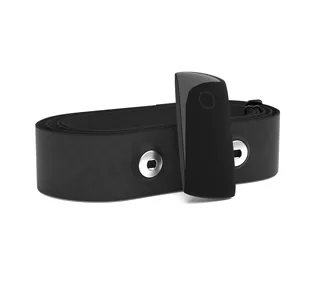
If heart-rate data is going to be part of your cycling routine, the monitor should fit your equipment setup and the devices you already use. ODIER offers several heart-rate monitoring options for riders and B2B buyers.
The HR52 heart rate monitor chest strap has a specified quiet-state accuracy of ±2 bpm, a measuring range of 30 to 240 bpm, ±1.5% accuracy, BLE 4.0 and ANT+ connectivity, IP67 waterproofing, and a CR2032 battery. These specifications make it suitable for riders who want heart-rate data that can integrate with compatible training equipment and cycling devices.
ODIER also lists the HR53 chest strap in its cycling training equipment catalog. For riders who prefer an arm-based format, the company also offers a rechargeable heart rate armband. Further specifications for those two products should be checked on their product pages rather than assumed.
For individual cyclists, the main buying question is whether the monitor fits your preferred wearing style and connectivity setup. For bike shops, teams, distributors, and private-label buyers, product selection may also include wholesale and OEM/ODM requirements.
Not necessarily in a simple one-to-one way. A higher heart rate generally signals a higher cardiovascular demand at that moment, but calorie expenditure is still an estimate influenced by the overall activity, duration, body weight, and the estimation method being used. Heart rate is most useful for judging intensity rather than converting every beat-per-minute value directly into a calorie number.
Heart rate alone is not enough to produce an exact calorie measurement. Consumer devices typically combine heart-rate data with personal information and proprietary algorithms. A transparent alternative is to use heart rate to judge intensity, then estimate calories with an activity-based method such as METs.
No. They can still be useful as consistent trend data if you understand their limitations. The Stanford study found substantial error in energy-expenditure estimates, so the number is better used as an approximation for comparing sessions than as a precise statement of calories burned.
A calorie estimate can provide general context, but it should not be treated as a precise measurement of what you must replace during or after a ride. For riders making nutrition or fueling decisions, especially for long or demanding training, it is safer to avoid treating a device calorie number as exact.
Understanding calories burned cycling is less about finding one perfect number and more about using the right tools in the right way. MET calculations give you a transparent estimate based on activity level, body weight, and time. Heart-rate monitoring adds live information about intensity. Research on consumer trackers shows why these two ideas should remain separate: heart rate can be measured reasonably well, while calorie expenditure may be estimated with much larger error.
For a practical cycling routine, monitor your heart rate, compare it with your normal training patterns, choose a realistic activity estimate, and treat calorie totals as approximations rather than facts. Riders who want to add heart-rate tracking can explore ODIER's HR52 chest strap, HR53 chest strap, and rechargeable heart-rate armband options. Bike shops, cycling teams, distributors, and private-label buyers can also contact ODIER at carrie@odier.com.cn for wholesale, OEM, or ODM inquiries.